How does the Euroclass system work?
The Euroclass system was introduced to harmonise standards across the EU. It categorises products into one of seven reaction to fire classes ranging from A1 down to F (the worst performing class in terms of combustibility), using a defined test or combination of tests. It also provides additional classification (typically associated with reaction to fire classes D – B) for smoke production (from s1 - little or no smoke, to s3 - substantial smoke) and flaming droplets / particles (from d0 - none, to d2 - quite a lot).
During its development, the European Commission’s Fire Regulators Group wanted the system to directly address the hazards in an actual fire scenario — a fire in a room. To do this, they used a room corner test (ISO 9705-1: 2016 - Room corner test for wall and ceiling lining products) as the reference point. Crucially, this test method was specifically designed to measure the burning behaviour of internal wall and ceiling lining products.
What tests are used within the Euroclass system?
When assessing construction products (other than flooring), the Euroclass system uses four tests:
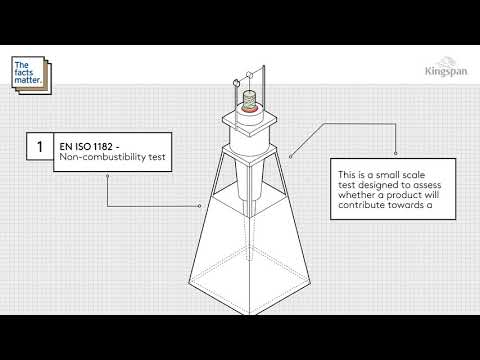
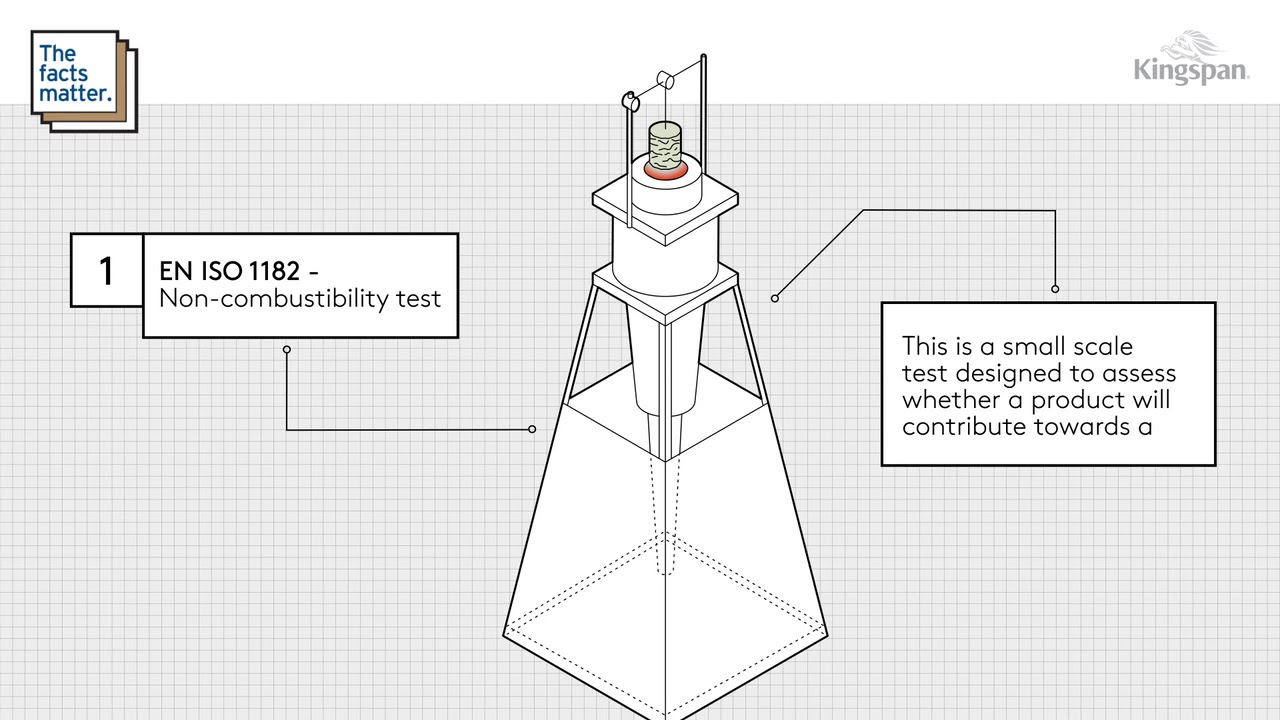
BS EN ISO 1182: 2019 (Non-combustibility test)
This is a small-scale test designed to assess whether a product will contribute towards a fire.
A small specimen is placed within the cylindrical furnace which is maintained at 750°C. During the 30 minute test, temperature changes on the surface and at the centre of the specimen are monitored via thermocouples (sensors). The specimen is also observed for signs of sustained flaming. At the end of the test, mass loss from the specimen is calculated.
The test criteria used within the Euroclass system are:
• ∆T – temperature rise on specimen thermocouples
• ∆m – mass loss of specimen
• tf - sustained flaming time
Note that data gathered from thermocouples inside the product specimen is used for information only and does not affect the classification outcome.
EN ISO 1716: 2018 (Determination of the gross heat of combustion (calorific value))
This is a small-scale test designed to calculate the maximum heat release of a specimen when burned completely.
A small test specimen is ground to a powder and ignited in a pressurised oxygen atmosphere within a calorimetric bomb. The bomb is located within water and temperature changes in the water are monitored during the burning. The gross calorific potential is then calculated based on the temperature change, specimen mass and other correction factors.
The test criteria used within the Euroclass system is PCS — gross calorific potential.
BS EN 13823: 2020 (Single burning item (SBI) test)
This is an intermediate scale test based on the reference room corner test (ISO 9705-1: 2016 - Room corner test for wall and ceiling lining products).
The product specimen is mounted on the trolley rig forming a room corner. It is exposed to flames with a heat release of 30 kW for a period of 20 minutes. Heat and smoke production is measured within the ducting for the exhaust hood and flame spread is observed throughout the test.
The test criteria used within the Euroclass system are:
- Total Heat Release (THR) — the total heat released in the evaluation period
- Lateral Flame Spread (LFS) — a simple measure of whether flames spread to the edge of the specimen
- Fire Growth Rate Index (FIGRA) — the speed at which heat release increases throughout the full test duration
- Total Smoke Production (TSP) — the total smoke produced during the evaluation period
- Smoke Growth Rate (SMOGRA) — the rate at which smoke production increases during the full 20-minute exposure period
- Flaming droplets / particles — any droplets / particles which continue to flame for longer than 10 seconds when they reach the ground is recorded during the first 10 minutes of the test
BS EN ISO 11925-2: 2020 (Single-flame source test / ignitability test)
A small-scale reaction to fire test designed to determine the ignitability of a vertical product specimen when exposed to a small flame.
Where products will be used in an application where the edge may be exposed to flame, the gas burner is mounted in three positions:
• surface exposure – 40 mm above the bottom edge of the specimen
• edge exposure – at the mid-point on the bottom of the specimen (specimen thicknesses ≤ 3 mm thick) or 1.5 mm behind the surface (> 3 mm thick)
• multi-layered products 10 mm or greater should be tested with the specimen turned at 90 degrees on it's vertical axis with the flame impinging at the bottom edge of the centreline of the underside of each different layer
The burner is lit with a flame height of 20 mm and the test begins as soon as this makes contact with the specimen. The flame can either be applied for:
• 15 seconds (with the specimen observed for a further 5 seconds)
• 30 seconds (with the specimen observed for a further 30 seconds)
The flame height and filter paper are observed throughout.
The test criteria used within the Euroclass system are:
• 15 second exposure with flame height not exceeding 150 mm within 20 seconds
• 30 second exposure with flame height not exceeding 150 mm within 60 seconds
• Does filter paper ignite
How are products classified within the Euroclass system?
Below is a summary of the primary classifications within the Euroclass system. Please note there are further tables for fire performance of floorings and linear pipe thermal insulation respectively. The below is taken from Table 1 from BS EN 13501-1.
Class | Test method(s) | Classification criteria | Additional classification |
A1 |
EN ISO 1182a and
| ∆T≤ 30 °C; and ∆m≤ 50%; and tf = 0 s (i.e. no sustained flaming) |
|
| EN ISO 1716 | PCS ≤ 2.0 MJ/kg a and PCS ≤ 2.0 MJ/kg b c and PCS ≤ 1.4 MJ/m2 d and PCS ≤ 2.0 MJ/kg e |
|
A2 | EN ISO 1182 a or | ∆T≤ 50 °C; and ∆m≤ 50%; and tf = 20 s |
|
| EN ISO 1716 and | PCS ≤ 3.0 MJ/kg a and PCS ≤ 4.0 MJ/m2 b and PCS ≤ 4.0 MJ/m2 d and PCS ≤ 3.0 MJ/kg e |
|
| EN 13823 | FIGRA0.2MJ ≤ 120 W/s and LFS < edge of specimen and THR600s≤ 7.5 MJ | Smoke production (see table below) and Flaming droplets / particles (see table below) |
B | EN 13823 and | FIGRA0.2 MJ ≤ 120 W/s and LFS < edge of specimen and THR600s≤ 7.5 MJ | Smoke production (see table below) and Flaming droplets / particles (see table below) |
| EN ISO 11925-21: Exposure = 30 s | Fs ≤150 mm within 60 s | Smoke production (see table below) and Flaming droplets / particles (see table below) |
C | EN 13823 and | FIGRA0.4 MJ ≤ 250 W/s and LFS < edge of specimen and THR600s≤ 15 MJ | Smoke production (see table below) and Flaming droplets / particles (see table below) |
| EN ISO 11925-21: Exposure = 30 s | Fs ≤150 mm within 60 s | Smoke production (see table below) and Flaming droplets / particles (see table below) |
D | EN 13823 and | FIGRA0.4 MJ ≤ 750 W/s | Smoke production (see table below) and Flaming droplets / particles (see table below) |
| EN ISO 11925-21: Exposure = 30 s | Fs ≤150 mm within 60 s | Smoke production (see table below) and Flaming droplets / particles (see table below) |
E | EN ISO 11925-21: Exposure = 15 s | Fs ≤150 mm within 20 s | Flaming droplets / particles (see table below) |
F | EN ISO 11925-21: Exposure = 15 s | Fs >150 mm within 20 s |
|
a For homogenous products and substantial components of non-homogenous products.
b For any external non-substantial component of non-homogenous products.
c Alternatively, any external non-substantial component having a PCS ≤ 2.0 MJ/m2, provided that the product satisfies the following criteria of EN 13823: FIGRA ≤ 20 W/s, LFS < edge of specimen and THR600s≤ 4 MJ, s1 and d0.
d For any internal non-substantial component of non-homogenous products.
e For the product as a whole.
h Pass = no ignition of the paper (no classification); Fail = ignition of the paper (d2 classification).
i Under conditions of surface flame attack and, if appropriate to the end-use application of the product, edge flame attack.
| Class | SBI Criteria |
Smoke Production | s1 | SMOGRA ≤ 30 m2/s2; and TSP ≤ 50 m2 within the evaluation period |
Smoke Production | s2 | SMOGRA ≤ 180 m2/s2; and TSP ≤ 200 m2 within the evaluation period |
Smoke Production | s3 | Product does not comply with either of the above |
Flaming Droplets / Particles | d0 | No flaming particles/droplets occur within the evaluation period |
Flaming Droplets / Particles | d1 | No flaming particles/droplets lasting longer than 10s occur within the evaluation period |
Flaming Droplets / Particles | d2 | Product does not comply with either of the above |